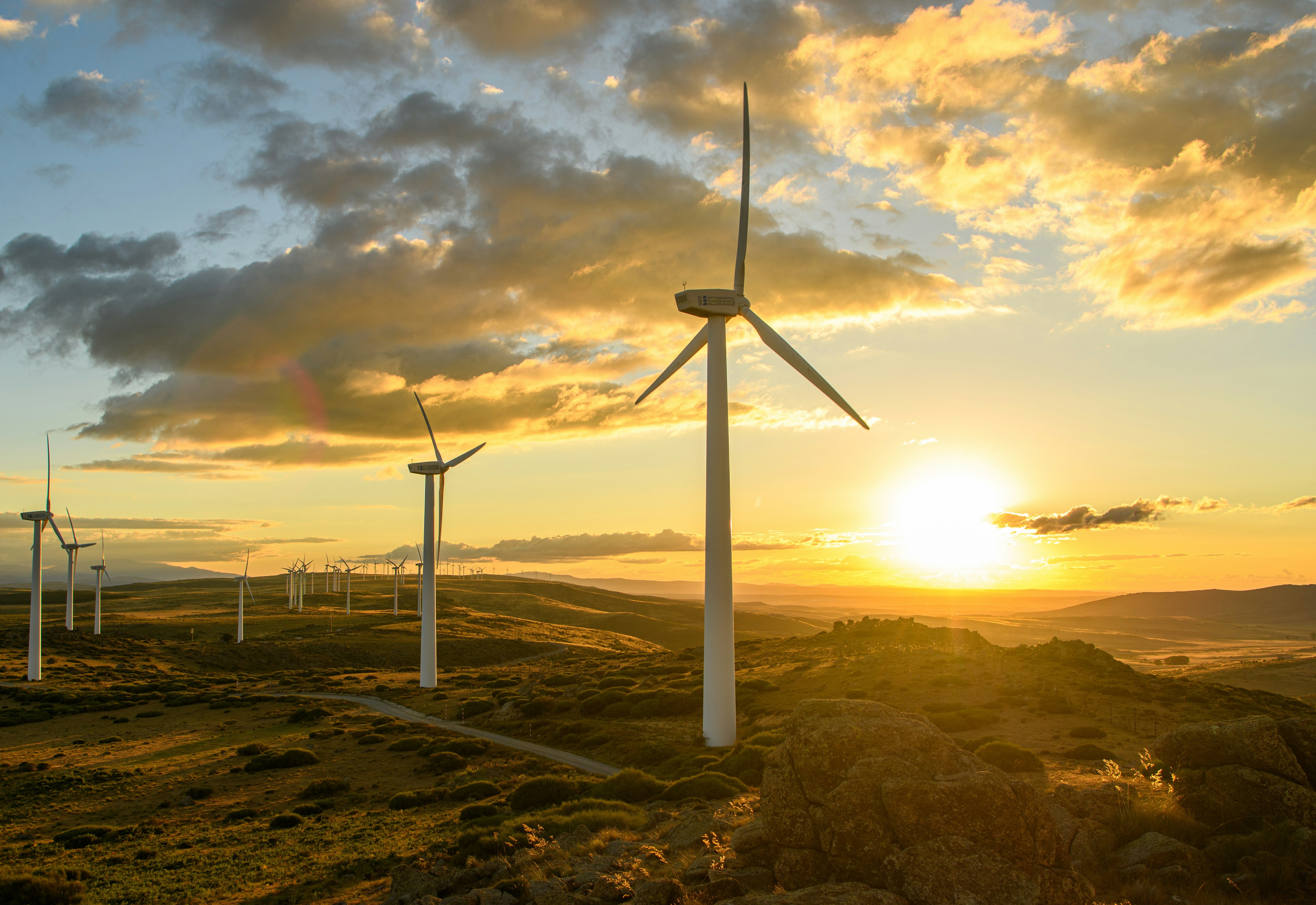
For a utility running wind and solar assets, the hardest part of producing clean energy isn't the turbines or the panels. It's knowing how much power they're going to deliver in the next few hours. Numerical Weather Prediction (NWP) models are the industry standard for that, but they carry systematic errors tied to local geography. A forecast can be consistently 8% too optimistic over one valley, or misread ramp-ups along a specific ridge line. Those biases translate directly into worse grid dispatch, more reliance on fossil-fuel backup, and lost revenue every time the schedule has to be re-balanced in real time.
MeteoFlow is the project we built with Iberdrola to close that gap. It has earned an "Excellent" rating in the IRCAI Global Top 100, the annual list curated by the International Research Centre on Artificial Intelligence under the auspices of UNESCO.
What the recognition means
IRCAI evaluates AI projects on two axes at once, technical depth and alignment with the UN Sustainable Development Goals. Out of hundreds of submissions worldwide, only 100 make the list each year, and only a subset within that list are rated "Excellent." For us, the rating matters less as a trophy and more as external validation that production-grade ML applied to critical infrastructure is being recognized in the same conversation as research from major labs and universities.
How MeteoFlow works
The problem is, on paper, a classic post-processing task. You take a raw NWP forecast and turn it into something you can actually dispatch against. In practice, the engineering is where it gets interesting.
The input side combines NWP forecasts, real-time observations from the assets themselves, and static features describing each site's terrain and exposure. Everything is aligned on a common time grid so the model sees a consistent picture per asset, per forecast horizon.
The model layer learns the residual, meaning the systematic gap between what the NWP predicted and what the asset actually generated, rather than re-forecasting from scratch. That choice matters. The NWP already encodes decades of atmospheric physics, and trying to replace it with a pure data-driven model is a losing trade. Learning the correction is cheaper, more stable, and easier to monitor in production.
The output is a calibrated forecast per asset, per horizon. Forecasts are versioned and reproducible, so when a forecast misses, the team can trace which inputs and which model version produced it.
What it delivers in practice
Better forecasts are not an academic improvement. For Iberdrola, three things change.
Dispatch decisions get cheaper, because the schedule submitted to the market matches reality more closely and incurs fewer imbalance penalties. Grid stability improves, because the operator can plan around intermittent generation with tighter confidence intervals. And the reliance on fossil-fuel backup drops, because reserve capacity is sized to actual uncertainty rather than worst-case uncertainty.
That last point is where the SDG alignment becomes concrete rather than abstract. Reducing forecast error on renewables is one of the most direct levers available for accelerating the energy transition (SDG 7 and SDG 13), and applying deep learning at the scale of a utility's full asset base, not a single research site, is exactly the kind of industrial AI that SDG 9 points to. The collaboration model itself, a specialized AI team working in deep technical partnership with a global utility, is SDG 17 in practice.
What's next
MeteoFlow is in production today. The next phase is to keep improving forecast accuracy and to make the system itself more efficient.
If you're working on forecasting, bias correction, or any problem where a physical model and observed data both need to feed the same decision, we'd be glad to talk. The full technical write-up sits on our Success Stories page, and the IRCAI announcement is on the IRCAI website.
Thanks to the team at Iberdrola for the trust, the data, and the operational depth that made this work possible.